
Health insurance can seem like a complex construct of American politics when you’re a teenager about to be propelled into the frightening adult world. With public schools teaching students that the mitochondria is the powerhouse of the cell, how are teenagers supposed to know which health insurance coverage best suits their needs?

https://www.usnews.com/news/healthiest-communities/articles/2019-02-07/lack-of-health-insurance-coverage-leads-people-to-avoid-seeking-care
In this news article written by staff writer, Gaby Galvin, of US News, she introduces health care insurance and the entanglement of the Affordable Care Act in addition to its effects it has had on health insurance. In a report published by the Commonwealth Fund, it shows that more Americans are insured compared to previous years, but they also tend to be underinsured. Because of this, out-of-pocket health care costs are becoming more expensive and common. In turn, people are putting off care or struggle to pay for medical expenses, which can lead to medical debt. A lot of these people that are underinsured tend to have an employer based health coverage. The president and vice president of the Commonwealth Fund strongly believe that policymakers should get involved and focus on workers and their employer based coverage.
“But the improvement in uninsured rates has stalled (and) more people have health plans that fail to adequately protect them from health care costs.”
Sara collins, lead author of the study and vice president of the commonwealth fund
Through this article, I used a lot of my previous knowledge gained in class. This includes the powers of the state and federal governments and the topics we talked about during Trump’s State of the Union address. From previous knowledge, I know that health care is not a constitutional right and that the federal government can uphold laws through it with the Elastic Clause. In addition to this, the article mentions the State of the Union address given by Trump merely days ago. Both in class and in the speech, dropping the cost of prescriptions were mentioned.
https://www.commonwealthfund.org/publications/issue-briefs/2019/feb/health-insurance-coverage-eight-years-after-aca
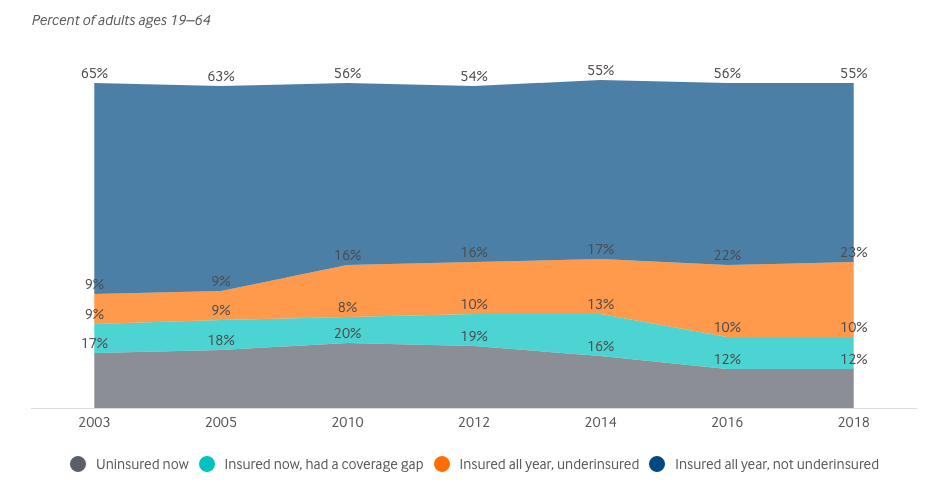
This data chart is from the Commonwealth Fund report mentioned in article. I pulled this chart out of the many that were available due to what it represents. This chart shows that less people are uninsured in 2018 compared to 2003. However, it also shows that there has been a major increase of those who are underinsured since 2003. In order for someone to be considered “underinsured” in this report, they must have been an adult who experienced “out-of-pocket costs, excluding premiums, equaled 10% or more of income; out-of-pocket costs, excluding premiums, equaled 5% or more of income if low-income (<200% of poverty); or deductibles equaled 5% or more of income.” (Collins, S. Bhupal, H. Doty, M.)
As I come to understand how health insurance policies work, I notice the limited amount of restrictions health insurance companies have. I agree with the idea presented by Dr. David Blumenthal, stating that policy makers should focus on “the erosion of employer coverage and its impact on workers.” In fact, there should be more federal policies focused on health insurance to protect the people. By simply providing federal programs to assist with health insurance, the people are still being taken advantage of and that is a real injustice. In addition, the concept of coverage gap is a major inconvenience and should not exist. The coverage gap can be eradicated through the use of careful planning of insurers.
Article: Lack of health insurance coverage leads people to avoid seeking care
Author: Gaby Galvin
Date of publication: February 7, 2019
Source: U.S. News & World Report
 American Health